Marcus Lau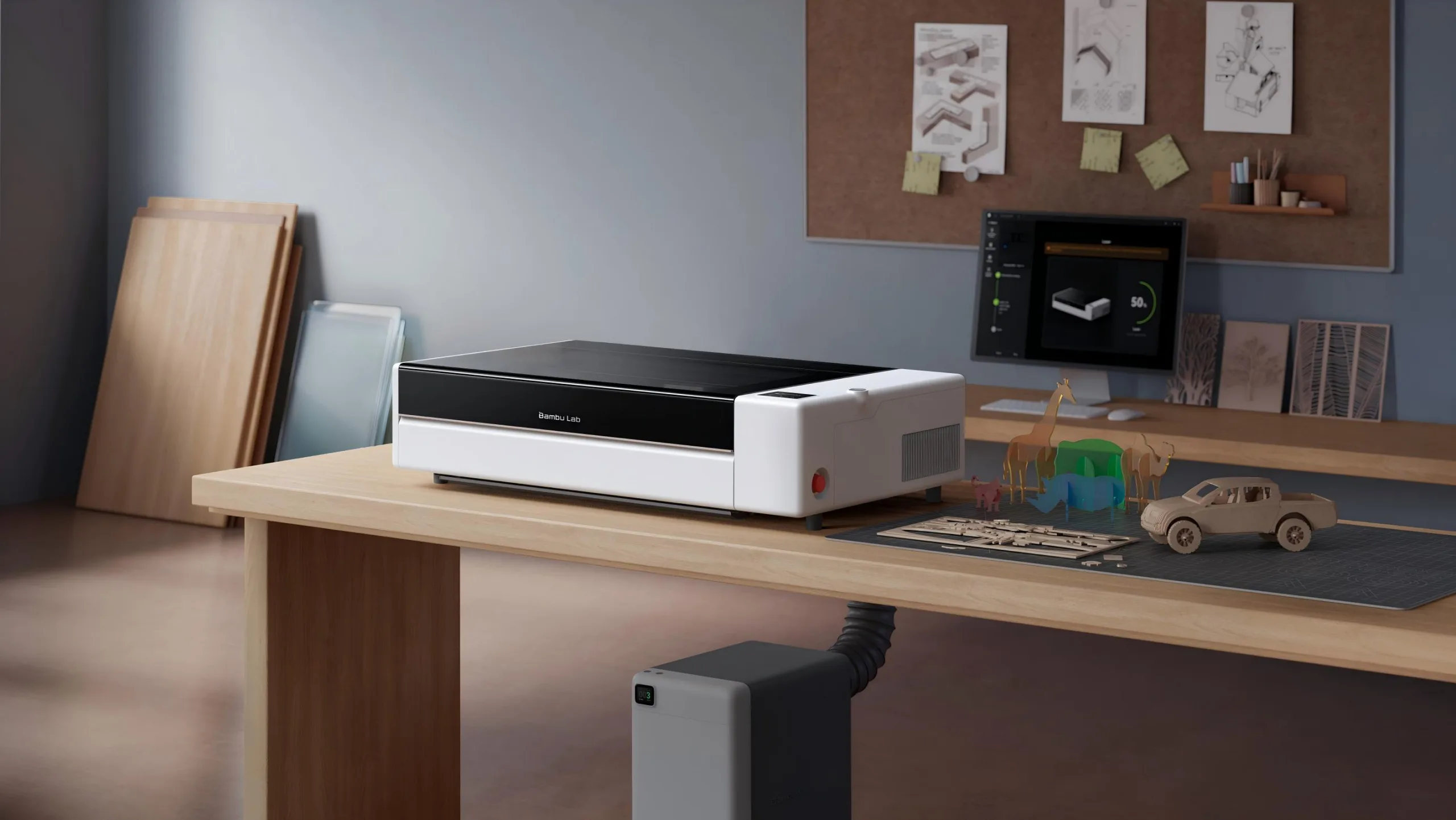
Brief News Summary
Bambu Lab opened R1 pre-orders on September 22, 2026 through bambulab.com. The $2,499 machine is the company’s first product outside 3D printing: a fully enclosed 55W CO2 laser cutter with a 600 x 300 mm bed, 1,000 mm/s top speed, and a motorized mirror-alignment system that finishes in about one minute. Shipping starts in October, with the EU store listing early November. The class is familiar, but Bambu is selling automation, not raw watts.
Key Upgrades & Highlights
Auto Laser Alignment: the thermal-paper ritual is gone
A CO2 laser bounces its beam off mirrors before it reaches the workpiece, and those mirrors drift. Traditionally you fire test pulses at thermal paper and nudge mounts by hand. The R1 clips a laser alignment sensor to the toolhead, reads the beam position directly, and drives motorized mirror actuators into place in about one minute.
Mirror alignment is the single biggest on-ramp pain in desktop CO2 lasers. xTool’s P2S guides you through the same chore manually, and OMTech’s hobby machines expect it on delivery day and after every bump. Bambu took the step that made its printers famous, automating a fussy calibration, and applied it to a machine class that still ships with hex keys and paper strips. For a first-time buyer, this removes the main reason CO2 lasers feel harder than diodes.
TriSense: two cameras, two lasers, dual encoders
The TriSense system pairs a BirdsEye camera over the bed with a toolhead camera, a pinpoint positioning laser, a distance-measuring laser for autofocus, and XY encoders that report toolhead position in real time. Positioning accuracy is listed at under 0.2 mm. A Vision Encoder accessory, sold at $99.99, pushes absolute motion accuracy under 0.1 mm across the full 600 mm travel.
Camera-based placement is what makes small engraving jobs practical: find a sticker outline and cut along it, or space a grid of names evenly on coasters without jig-making. Diode machines fake this with a single overhead camera; the R1 adds surface-height reading, so it focuses and engraves evenly across curved objects like bowls. The encoder truth-check matters for long jobs, where belt wear slowly shifts real position. Under 0.1 mm over 600 mm is metrology-grade territory for a $2,499 desktop machine.
55W CO2 with real cutting depth
The 10,600 nm CO2 tube cuts up to 15 mm black walnut plywood and 20 mm acrylic with the short-focus lens that ships in the box. Medium and long focus lenses, sold separately, extend walnut cutting to 18 mm. Spot sizes run 0.11 mm short, 0.17 mm medium, 0.19 mm long. Speed tops out at 1,000 mm/s with 20,000 mm/s² acceleration.
Depth numbers separate CO2 from diode classes. A 20W diode crawls through 10 mm plywood in multiple slow passes; 55W of CO2 slices 15 to 20 mm in one, and cuts clear acrylic, which diodes cannot. The glass tube does need liquid cooling: Bambu includes antifreeze and asks for 1,500 ml of distilled water, a small chore new owners should expect. The optional Conveyor accessory extends stock capacity to 3,000 mm, putting furniture-scale signage within reach of a benchtop machine.
Class 1 safety with a fire watch
In its enclosed configuration the R1 is rated Class 1 under IEC 60825-1, the strictest consumer laser rating. Lid-open stops, flame detection, a safety key, and an emergency stop are standard. An Auto Fire Extinguishing System is optional, and the E1 Pro Air Purifier connects to the exhaust outlet.
A 55W CO2 tube starts real fires, so this list is not marketing padding. Most open-frame diodes carry Class 4 beams and demand goggles. Full containment means the R1 can live in a home office without a ventilation build-out, though the exhaust hose still needs a window or the $899 purifier. The pass-through opening for long stock uses an air curtain to hold fumes inside, a detail that shows the enclosure was designed, not adapted.
Specifications
| Laser | 55W CO2, 10,600 nm, glass tube (water-cooled) |
| Work Area | 600 x 300 mm; 600 x 3,000 mm with Conveyor |
| Max Cutting | 15 mm walnut plywood (short lens, in box); 18 mm (medium/long lens); 20 mm acrylic |
| Engraving | Wood, acrylic, leather, fabric, paper, EVA foam, shell; glass, ceramic, coated metal (engrave only) |
| Speed | 1,000 mm/s at 20,000 mm/s² |
| Spot Size | 0.11 mm short / 0.17 mm medium / 0.19 mm long focus |
| Positioning | Under 0.2 mm; under 0.1 mm over 600 mm with Vision Encoder ($99.99) |
| Vision | TriSense: BirdsEye camera, toolhead camera, pinpoint laser, distance laser, XY encoders |
| Alignment | Auto Laser Alignment, motorized mirrors, about 1 minute |
| Safety | Class 1 (IEC 60825-1), lid-open stop, flame detection, safety key, e-stop; optional auto fire extinguisher |
| Air Assist | Built-in pump, 30 L/min at 30 kPa |
| Footprint / Weight | 940 x 560 x 200 mm, 33.5 kg |
| Power | 780 W max, 100-240 VAC |
| Software | Bambu Suite (Windows, macOS), Wi-Fi and USB, color touchscreen |
| Price | $2,499 US / €2,499 EU / £2,249 UK |
| Availability | Pre-orders since September 22, 2026; shipping from October (EU store: about November 6) |
Editor’s Take & Industry Impact
The R1 speaks to two groups at once. Bambu printer owners get a laser that speaks the same software language and finishes the workshop. And first-time laser buyers get Class 1 containment, autofocus, and self-alignment without learning the mirror ritual that older brands assume. Small sign shops and Etsy sellers cutting 6 to 15 mm stock daily are the core commercial case.
The competitive frame is simple. xTool’s P2S 55W covers the same wattage and a similar 600 mm bed, and its base price undercuts the R1. OMTech and Monport sell raw cutting power for less again. What $2,499 buys here is the automation stack: one-minute mirror alignment, TriSense positioning, autofocus on curved surfaces, and Bambu Suite. Tom’s Hardware handed the R1 an Editor’s Choice on day one, which is a strong signal for a first attempt in a new category. Honest note: our read rests on the official spec sheet and early reviews, not our own burns.
Three real frictions surfaced in early coverage. Cutting at the full 18 mm depth requires swapping focus lenses, a six-screw job that Tom’s Hardware called tedious and hopes Bambu redesigns with a quick release. The material preset library is thin, so fine-tuning falls on the user. And the cooling fans run loud, about 68 dB at full load by one measurement. Budget math also matters: the purifier is $899, and the lenses, conveyor, riser, and rotary are all extras. If you already own a P2S and know mirror alignment, the upgrade case is thinner. If this is your first CO2 machine, the automation is worth the premium.