Marcus Lau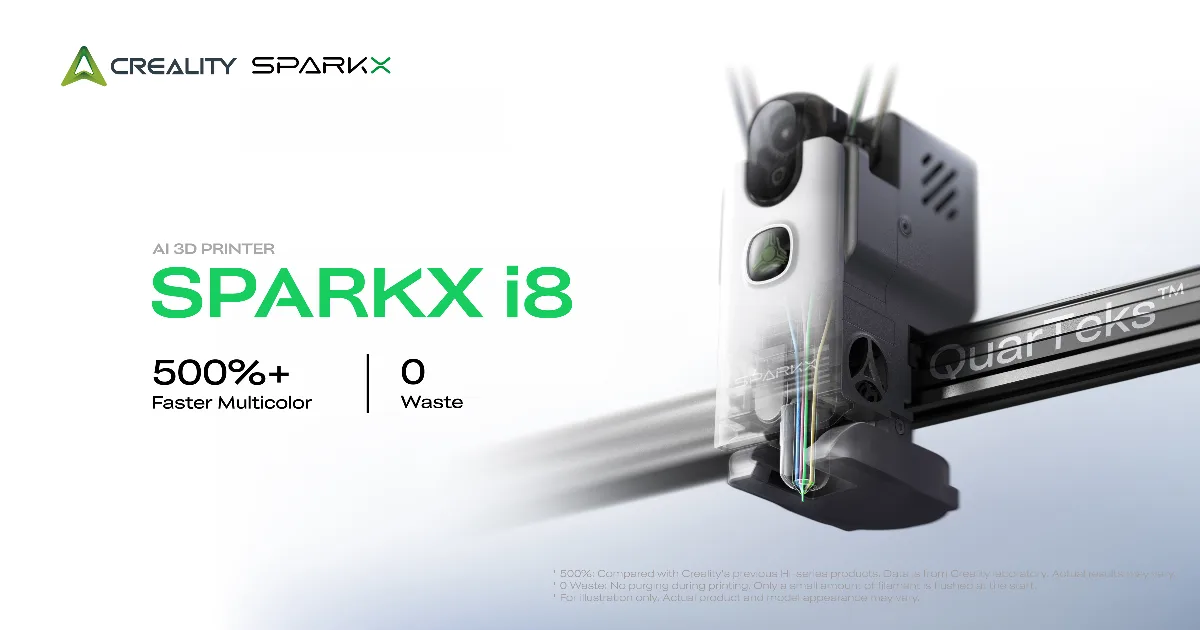
Brief News Summary
Creality opened the SPARKX i8 campaign on Indiegogo on September 21, 2026. The four-color printer uses the QuarTeks system: four filament channels packed into one hotend, with a shared path under 1 mm. Color changes finish in under a second, and Creality says the machine produces zero external purge waste. The campaign passed $1 million in its first 40 minutes and topped $2.1 million within two days. Orders ship from the factory in October, with delivery expected in November 2026.
Key Upgrades & Highlights
QuarTeks: four filaments, one hotend, less than 1 mm of shared path
QuarTeks keeps four spool channels ready inside a single toolhead. An internal mechanism selects the target channel right at the nozzle. Creality measures the shared path at under 1 mm, versus 35 mm or more in external multi-material units.
Shared path length is the real number behind multicolor speed. Every color change must flush the mixed transition filament out of that path. An AMS-style unit pushes 35-plus mm of waste each swap; the i8 pushes almost none, so changes drop from minutes to under a second. Creality ran a lab tower needing 3,000 switches in about 18 hours and calls the result 500 percent faster than external-feed systems. That is a company benchmark, not an independent one, but the physics behind it checks out.
No prime tower: purge goes into the infill
Instead of printing a scrap tower beside the model, the i8 routes color transitions into the infill the print needs anyway. A dedicated internal structure, which Creality calls a clean wall, catches residue. No prime tower means less filament, less time, and no tower-fall failures. Creality notes the mode does not apply to every model.
Purge towers are the hidden tax of multicolor printing. On color-dense parts they can eat a third of a spool and add hours. Bambu’s AMS and Creality’s own CFS both rely on them. Folding transitions into infill attacks the cost directly: a 300-swap print that wastes 40 percent on an external unit could drop to roughly 10 to 15 percent here. Independent tests will decide the exact number, but no consumer system under $400 has tried this approach before.
CMYK mixing: 16 to 32 shades from four spools
Four base filaments print in layered CMYK blends. By alternating thin layers of different colors, the i8 approximates a wider palette. Creality claims 16 to 32 distinct color combinations from the four channels.
Layer mixing is not true color matching, and Creality admits it: you will not hit a brand Pantone with four spools. But for figurines, toppers, and decor, the shade range beats a plain four-slot AMS, which gives you exactly four. The catch sits in the print time, since stacked layers multiply the layer count on gradient parts.
13 sensors and an AI camera watching four channels
Thirteen sensors track filament feed and position across all four channels in real time. An AI vision camera detects spaghetti failures and air printing, and Creality Cloud adds remote monitoring. The hotend swaps out in five seconds, and a redesigned cutter slices all four filaments at once for unloading.
Four channels means four ways to jam. On a standard single-path machine, an empty spool at hour six wastes a full build plate. Channel-level detection catches the break before the nozzle runs dry. The 81-point auto leveling and full-frequency input shaping round out the spec, and the printer arrives 90 percent pre-assembled.
Specifications
| Print Channels | 4 filaments in one hotend (QuarTeks) |
| Color Change Time | Under 1 second |
| Shared Path | Under 1 mm (vs 35+ mm external units) |
| Purge Waste | 0 g external purge during printing; small flush at start |
| Color Mixing | CMYK layered mixing, 16-32 combinations |
| Build Volume | 260 x 260 x 255 mm |
| Sensors | 13 filament/position sensors, AI camera failure detection |
| Leveling | 81-point auto leveling, automatic Z-offset |
| Hotend | 5-second quick-swap, 300°C max (reported) |
| Build Plate | 100°C max (reported), open frame |
| Assembly | 90% pre-assembled |
| Connectivity | Wi-Fi, Creality Cloud, remote monitoring |
| Campaign | Live now through October 31, 2026 |
| Price | $289 super early bird (sold out) / $309 early bird / $399 MSRP |
| Shipping | Factory October 2026, delivery November 2026 |
Editor’s Take
The i8 targets small multicolor sellers: keychain shops, topper makers, and hobbyists tired of feeding a prime tower. At $289 to $399 it undercuts the Bambu A1 Combo, which lists around $449 with the AMS lite, and removes the external unit from the desk entirely. The 260 mm bed and family-friendly SPARKX branding put it next to the i7, its single-color sibling from CES 2026.
The pitch splits the multicolor market into three lanes. External feeders like the AMS stay cheap and flexible but slow and wasteful. Toolchangers like Creality’s own K3 KliTek hit near-zero waste at two to four times the price. QuarTeks claims most of the waste win at AMS money, which is why the campaign cleared $2 million in two days. Two caveats matter. First, the 80 percent waste reduction and 500 percent speed figures are Creality’s lab numbers. Second, the shared path is under 1 mm but not zero, so this is low purge, not the true zero purge of a toolchanger.
The open frame is the honest limit. With a 300°C hotend but no enclosure, the i8 is a PLA, PETG, and TPU machine. Printers wanting ABS, ASA, or nylon should look at enclosed options. Early birds should also note the first-24-hour perk: the first 1,000 backers get shipping and taxes refunded up to $50, capped at one unit. If the zero-waste claim survives backer testing, the i8 resets what $399 buys in multicolor. If it does not, the $399 A1 Combo path remains the safe bet. We will update once units reach backers in November.