Marcus Lau
Brief News Summary
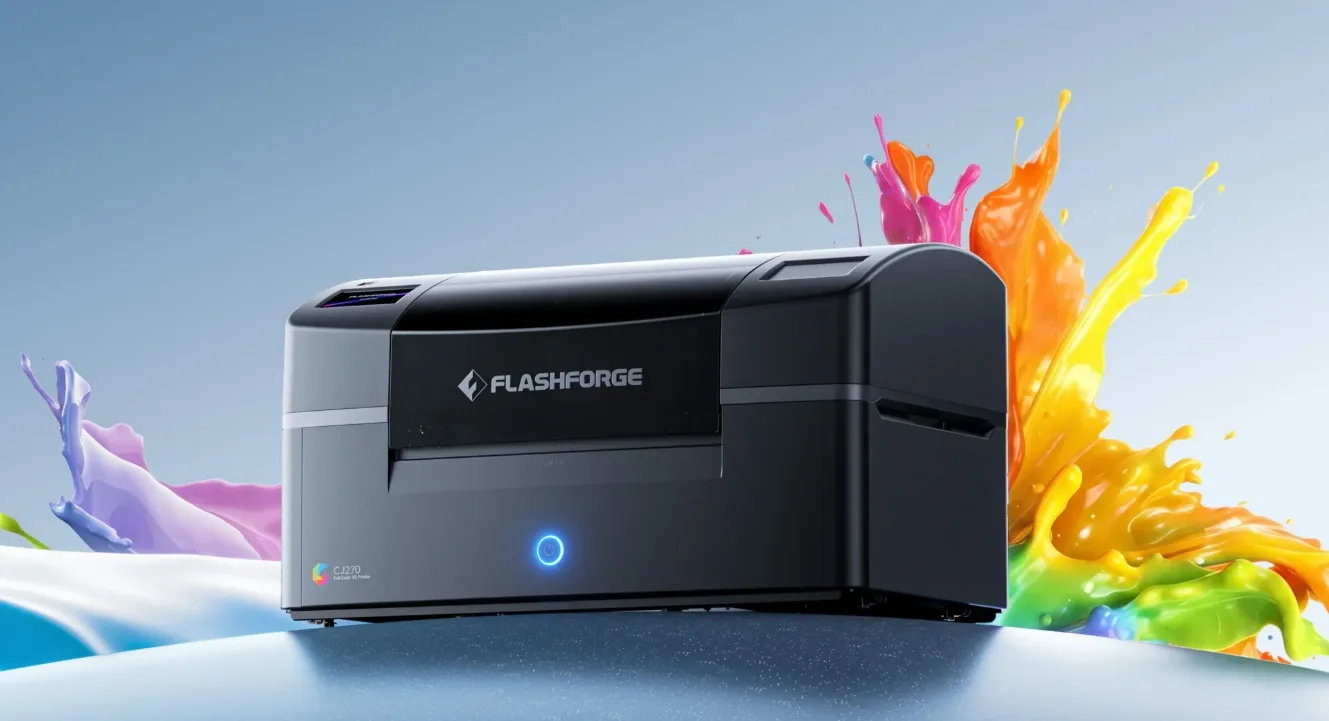
Flashforge started selling the CJ270 on October 10, 2026 at ¥34,999 in China (about $4,900), with US pre-orders listed at $3,999, down from $4,499. The desktop machine uses industrial MJP material jetting to print full-color parts with over 10 million colors, 7-micron minimum layers, and water-soluble supports. Japanese pre-sales opened October 13 through APPLE TREE at ¥635,000.
Key Upgrades & Highlights
Seven printheads, ten million colors, zero painting
The CJ270 runs seven industrial inkjet heads that jet six build resins (CMYK, white, and clear) plus a water-soluble support material, curing each layer with UV light. Colors mix during printing, so gradients, skin tones, and translucent sections come out finished. A dedicated black channel keeps outlines pure instead of the muddy gray that CMY mixing produces.
Desktop color printing until now meant two compromises. FDM multi-color systems like Bambu’s AMS swap filaments and produce layered, banded color. UV printers such as eufyMake’s E1 do 2.5D relief on flat surfaces, not true solid parts. The CJ270 builds real three-dimensional objects with color inside the material, the same approach as industrial Stratasys PolyJet machines that cost hundreds of thousands of dollars. For figure makers, the practical difference is deleting the paint booth: a printed character arrives with skin, clothing, and eye detail done. HeyGears’ G1 raised $17.4 million on Kickstarter chasing the same idea; Flashforge is the first major brand to ship it at retail.
7-micron layers with a leveling roller
Minimum layer height is 7 microns, about 0.007 mm. After each layer is jetted, an industrial leveling roller compacts the material flat before UV curing, keeping edges and detail consistent all the way to the 100 mm maximum height.
Resin printers advertise 20-35 micron XY pixels, but layer lines still show on curved surfaces. Seven-micron layers are an order of magnitude finer, and the roller matters as much as the number: jetted droplets without leveling create ripples that collect dirt and scatter light. Flashforge claims clean edges and stable color registration even at full height, which is where jetted prints usually degrade. For figurines and miniatures viewed at arm’s length, this is the difference between a prototype and a sellable product.
Water-soluble supports end the knife work
Support structures dissolve in water, with or without an ultrasonic bath, in roughly 30 minutes to an hour. No alkaline chemicals, no scraping delicate undercuts with a blade.
Delicate support removal is where finished resin parts die. A snapped finger or scarred face ruins hours of printing. Water-soluble support changes the calculus for complex parts: overhangs, tucked arms, and internal channels become printable without post-print surgery. On an MJP machine, the support material is jetted as a separate material, so it releases cleanly from every surface. For a studio producing customer orders, faster cleanup directly raises daily output, and it removes the sharpest tool from a workflow that beginners find intimidating.
Maintenance built for seven heads
Each of the seven heads has an independent ink supply. White ink auto-stirs to prevent settling, heads self-clean with an automatic wipe every 2,000 movements, and a failed head can be replaced individually instead of swapping the whole assembly.
Multi-head printers live or die on service economics. If one clogged nozzle meant replacing a seven-head assembly, running costs would rival the purchase price. Independent replacement changes the math entirely, and automatic wiping every 2,000 movements attacks the settling and crusting that kills inkjet heads left idle. White ink circulation and stirring mirror what DTF printer makers learned the hard way. The accompanying ColorPrint slicer adds color preview and support optimization, so color assignments happen before printing, not during cleanup.
A desk is enough machine
The CJ270 measures 697 x 410 x 405 mm and weighs 33.5 kg. Build volume is 180 x 120 x 100 mm, sized for figurines, miniature scenes, and appearance prototypes.
Full-color jetting machines historically needed a dedicated room. At 33.5 kg on a 70 cm footprint, the CJ270 fits an office desk next to a regular printer. The 180 x 120 x 100 mm build volume is the real limit: full-size cosplay props and architectural models will not fit, and printing anything larger means sectioning. But for the target work, character figures, board game pieces, product mockups, and educational models, the volume is workable, and Flashforge positions the machine as a complement to its Creator 5 Pro FDM line rather than a replacement.
Specifications
| Technology | MJP material jetting with UV curing |
| Printheads | 7 industrial inkjet heads, independently replaceable |
| Materials | CMYK + white + clear build resins, water-soluble support |
| Colors | Over 10 million color combinations, G7 color management |
| Layer Thickness | 7 µm minimum, industrial leveling roller per layer |
| Build Volume | 180 x 120 x 100 mm |
| Support Removal | Water soluble, 30-60 minutes soak or ultrasonic |
| Maintenance | White ink auto-stir, head auto-wipe every 2,000 moves, per-head replacement |
| Software | ColorPrint slicer with color preview and support optimization |
| Dimensions / Weight | 697 x 410 x 405 mm, 33.5 kg |
| Price | $3,999 US (list $4,499); ¥34,999 China; ¥635,000 Japan |
| Availability | On sale October 10, 2026 (China); Japan pre-sale from October 13 |
Editor’s Take
Based on Flashforge’s official product materials, Chinese launch coverage, and Japanese pre-sale announcements as of October 22, 2026. No review unit tested.
The CJ270 is for creative studios, custom figure businesses, design teams, and educators, buyers who currently outsource full-color printing or hand-painted resin output. It complements Flashforge’s FDM line: the Creator 5 Pro makes functional parts, and the CJ270 makes finished-looking ones. If your output is mechanical brackets, this machine is irrelevant. If your output looks like toys, collectibles, or display models, it reads like a small factory.
The price cuts the entry cost of true full-color jetting by roughly 90%. Comparable capability previously meant industrial PolyJet-class systems with six-figure price tags and service contracts. HeyGears’ G1 is the nearest challenger and raised $17.4 million on Kickstarter, but its crowd delivery is still ahead; Flashforge ships today through established retail channels in three markets. At $3,999 US, the CJ270 costs less than a Bambu H2D Pro plus a year of outsourcing paint work. Material pricing remains the unknown: jet resins historically cost far more per liter than filament, and Flashforge has not published US consumable prices.
Three honest limits. The 180 x 120 x 100 mm build volume is small; anything bigger needs sectioning and bonding. Inkjet heads are consumables, and seven of them are seven failure points regardless of the modular design. And there are no independent color-accuracy or long-term reliability tests yet. Studios with steady demand for finished color parts should take the machine seriously now. Hobbyists printing a few figures a month will get more value from a $300 resin printer and patience.
FAQ
What can the CJ270 print?
Full-color figurines, miniatures, architectural models, product appearance prototypes, and educational models in CMYK, white, and clear resin with water-soluble supports, at layers down to 7 microns.
How does the CJ270 compare to the HeyGears G1X?
Both target desktop full-color jetting. The CJ270 ships at retail now at $3,999; the G1X raised $18 million on Kickstarter with deliveries still pending. The CJ270’s seven heads include a dedicated black channel and clear material.
Do prints need painting?
No. Colors form inside the material during printing, including skin tones, gradients, and translucent sections. Display pieces may still benefit from polishing or a gloss coat.