Marcus Lau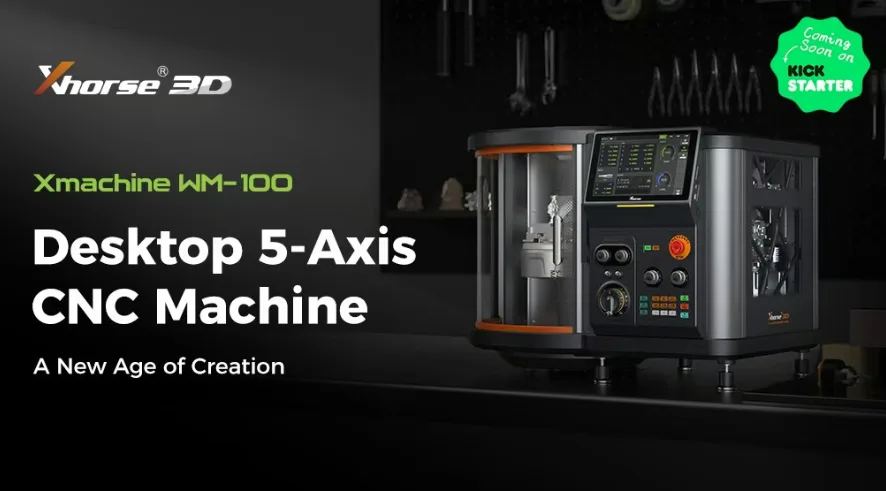
Xhorse3D unveiled the WM-100 on August 15, 2026, at MetAI Hub Shanghai. It is a desktop 5-axis CNC that claims true simultaneous RTCP control, not the common 3+2 approach. The machine comes from Xhorse3D, a brand incubated by Xhorse. Xhorse has built precision manufacturing equipment since 2010 and now runs 500-plus engineers, 600-plus patents, and a 100,000 square meter smart factory. The WM-100 runs a self-designed 1,500W spindle at 20,000 RPM and claims ±0.01 mm repeatability. A $50 refundable deposit locks a $5,699 VIP Kickstarter price.
Key Upgrades & Highlights
RTCP Simultaneous 5-Axis: Not 3+2 Positioning
Most desktop CNCs sold as 5-axis use 3+2 indexing. The rotary axes lock during cutting, then reposition between passes. The WM-100 runs true RTCP (Rotary Tool Centre Point), where all five axes move together in real time and the controller keeps the tool tip tangent to the surface throughout the entire cut.
For turbine blades, medical implants, and aerospace brackets, 3+2 leaves visible step patterns between indexed positions that require manual polishing. RTCP eliminates those steps. Industrial 5-axis machines from DMG MORI or Haas have done this for years, but they start at $80,000-plus. The WM-100 brings the same motion logic to a 130 kg desktop footprint at roughly 7% of that cost. The Pocket NC V2 also claims RTCP at a similar price, but with a 500W spindle versus the WM-100’s 1,500W.
On-Board AI CAM: From Photo to G-Code
XMaker accepts four input types: import an STL or STEP file, type a text prompt, upload a photo, or scan a real object with the built-in laser. It then auto-selects tools, generates feeds and speeds, builds 5-axis toolpaths, runs a collision simulation, and sends G-code directly to the machine.
CAM software is the steepest learning curve in CNC. Fusion 360’s manufacturing module takes 40-plus hours to learn for basic 5-axis work. XMaker aims to collapse that to minutes. If it works as claimed, a maker with zero CAM experience could machine a complex part the same day they unbox the machine. Users who prefer traditional CAM can still export standard G-code from Fusion, Mastercam, or PowerMill. The InfiMaker K1 offers a similar AI CAM called InfiStudio, but XMaker adds the laser scan input that InfiStudio lacks.
Blue Laser Workpiece Scanning
A built-in blue laser module scans the workpiece surface before cutting. It detects part position, orientation, and any deviation from the CAD model without touching the part. No manual zero-setting is needed.
On a typical desktop CNC, zeroing takes 5-10 minutes with a touch probe or paper-shim method. If the part shifts during setup, the entire job is ruined. The laser scan compensates for position errors automatically. Makera’s Carvera uses a touch probe for similar auto-zeroing, but laser scanning is faster and works on irregular surfaces where a physical probe cannot reach. This is the kind of automation that separates a production tool from a hobby machine.
6-Tool Automatic Changer with Live Camera
A 6-slot carousel preloads roughing, finishing, drilling, and engraving tools. The machine swaps them mid-job without pausing. A built-in camera streams the cut in real time to a phone or computer.
Manual tool changes on desktop CNCs like the Shapeoko or Genmitsu 3018 break the workflow every 10-15 minutes for multi-tool parts. You start a job, wait, stop, swap the bit, re-zero, restart. The ATC on the WM-100 means you can load a 6-tool job and walk away. Industrial VMCs have had ATCs for decades, but this is a first for a desktop 5-axis in this price range. The InfiMaker K1 matches with its own 6-slot changer, but the WM-100 adds the live camera feed for remote monitoring.
Dual Cooling: Air and Mist in One Machine
A switchable system runs air cooling for wood, acrylic, and wax, then switches to mist coolant for aluminum, brass, and steel. The changeover is software-controlled from the XMaker interface.
Most desktop CNCs run dry, no coolant at all. Cutting aluminum dry means tool life drops to 20-30% of rated capacity and surface finish suffers. The InfiMaker K1 goes further with high-pressure closed-loop coolant, which is better for hard metals like titanium. The WM-100’s dual-mode approach trades peak performance for flexibility. The claim of 2.5x tool life with proper coolant aligns with published data from Sandvik and Kennametal, though real-world results depend on feed rate and depth of cut.
Specifications
| Machine Type | Desktop simultaneous 5-axis CNC |
| Spindle | 1,500W, 20,000 RPM (self-designed) |
| Repeatability | +/- 0.01 mm |
| 5-Axis Work Area | 100 x 100 x 100 mm |
| 4-Axis Work Area | 150 x 150 x 120 mm |
| 3-Axis Work Area | 150 x 200 x 120 mm |
| Tool Changer | 6-slot automatic (ATC) |
| Cooling | Air or mist, switchable |
| Materials | Steel, aluminum, brass, copper, wood, acrylic, wax, jade |
| Positioning | Blue laser 3D scanning, optical visual positioning |
| Monitoring | Built-in camera with live feed |
| Software | XMaker AI CAM; standard G-code with third-party post-processors |
| Dimensions | 797 x 614 x 580 mm |
| Weight | ~130 kg |
| Noise | ~50 dB (lab tested, door closed) |
| Price | $5,699 VIP / $5,899 Super Early Bird |
Editor’s Take & Industry Impact
Based on the official spec sheet and the product demonstration at MetAI Hub Shanghai on August 15, the following analysis is preliminary. We have not independently tested the WM-100.
The WM-100 targets a narrow but growing group: small-machine-shop owners who need 5-axis capability for complex parts but cannot justify a $60,000-plus industrial machine. It also targets university makerspaces and R&D labs that teach multi-axis machining. At $5,699 VIP, it sits well below the entry point of any other true RTCP 5-axis machine on the market. The closest competitor is the Pocket NC V2 at roughly $5,000, but the WM-100 triples the spindle power (1,500W vs 500W) and adds a 6-tool ATC that the Pocket NC lacks entirely. The InfiMaker K1 at $5,199 is the other direct rival, and the two machines share almost identical core specs.
The main risk is delivery. Kickstarter hardware campaigns slip regularly, and true RTCP on a desktop machine is an engineering challenge that has humbled larger companies. The absence of a published ISO 230-2 accuracy standard is a gap. Xhorse has the manufacturing muscle (500-plus engineers, 600-plus patents, 100,000 sqm factory), but making a prototype and shipping 500 units are different problems. If you need 5-axis now and cannot wait, the Pocket NC V2 is the safer if less capable choice. If you can accept the risk, the WM-100’s spec sheet offers more value per dollar than anything else in this category. Wait for the campaign to go live and read early backer reviews before pledging.
FAQ
When is the Xhorse3D WM-100 available?
The Kickstarter pre-launch page is live. Xhorse3D has not announced the exact campaign start date. Shipping is expected after the campaign closes, likely late 2026 or later.
How much does the WM-100 cost?
A $50 refundable VIP deposit locks a $5,699 price. The Super Early Bird on Kickstarter is $5,899. Retail pricing is not confirmed.
What materials can it machine?
The company lists steel, aluminum, brass, copper, wood, acrylic, wax, jade, and more than 100 other materials.
Do I need CAM experience?
No. XMaker AI CAM can generate toolpaths from a text prompt or a photo. You can also import STL or STEP files. Experienced users can export standard G-code.
What is true simultaneous 5-axis RTCP?
RTCP stands for Rotary Tool Centre Point. All five axes move continuously while the controller keeps the tool tip aligned with the part. This is different from 3+2 machines that lock the rotary axes during each cut.