Marcus Lau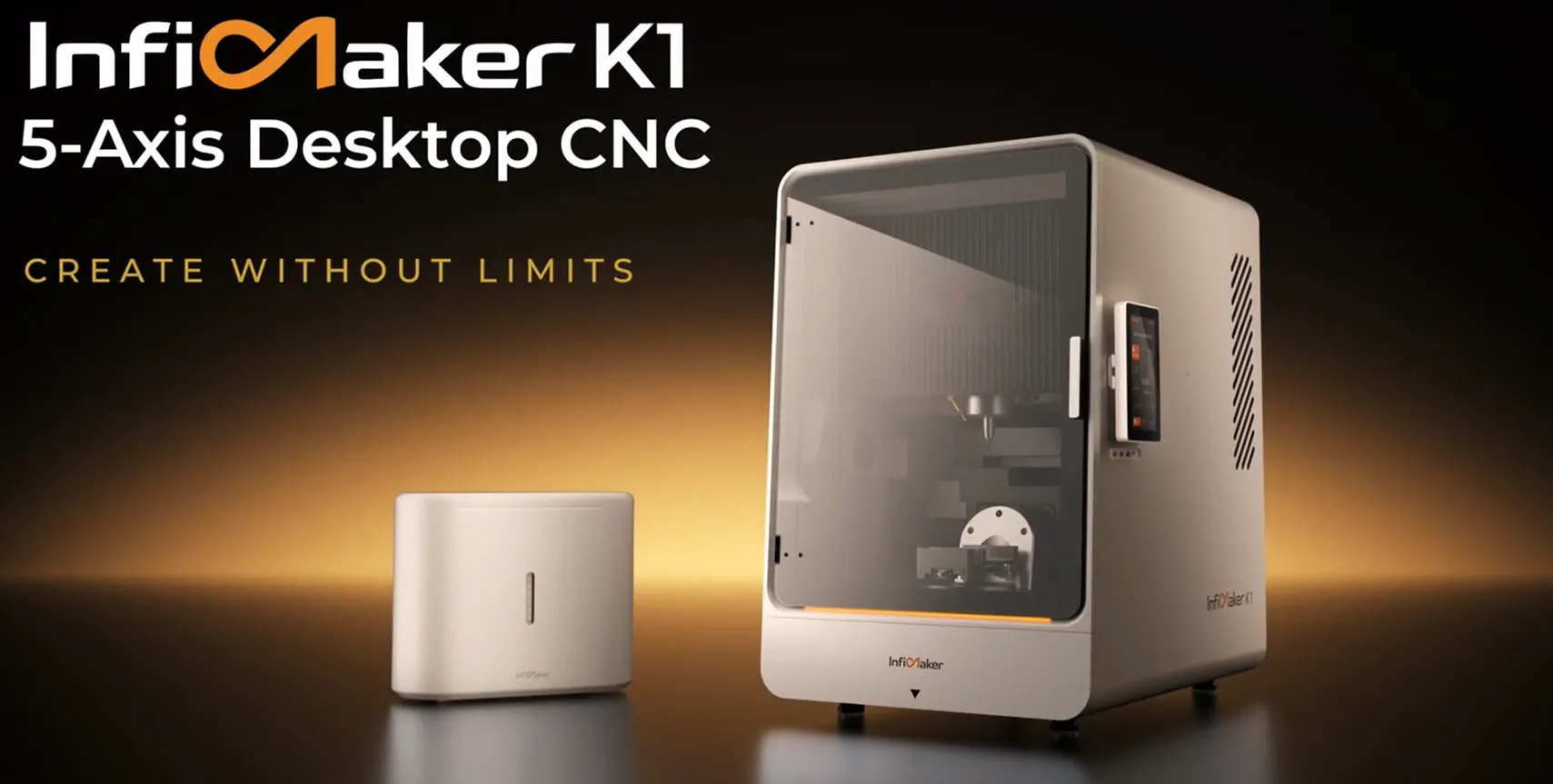
InfiMaker launched the K1 on Kickstarter on August 13, 2026. The campaign passed $3.37 million in pledges against a $49,996 goal in the first week. The K1 is a desktop simultaneous 5-axis CNC with a 1,500W spindle, 6-tool automatic changer, and AI-assisted CAM. Super Early Bird pledges start at $5,199, which is 40% below the $8,599 planned retail price.
Key Upgrades & Highlights
RTCP Simultaneous 5-Axis with Motinfi Controller
The K1 runs InfiMaker’s self-developed Motinfi motion controller with RTCP (Rotary Tool Centre Point). The B-axis tilts from -30 degrees to +110 degrees, and the C-axis rotates a full 360 degrees. All five axes move simultaneously during cutting, not in the 3+2 indexing style common at this price.
3+2 machines stop, reposition rotary axes, then resume cutting, which leaves visible step marks on curved surfaces. True simultaneous motion produces smooth continuous surfaces on parts like impellers, dental abutments, and custom orthotics. Industrial 5-axis controllers from Siemens or Heidenhain cost more than the entire K1 machine. The Motinfi system puts comparable motion logic into a $5,199 desktop package. The Xhorse3D WM-100 also claims RTCP, but neither machine has been independently tested for accuracy against an ISO standard.
Largest 5-Axis Envelope in Its Class
The 5-axis work area is 120 x 120 x 120 mm. In 3-axis mode, it opens up to 220 x 150 x 150 mm. InfiMaker claims this is 72.8% more 5-axis machining volume than similarly sized desktop 5-axis machines like the Pocket NC V2.
A 100mm cube, which is what the Xhorse3D WM-100 offers, limits you to small parts: jewelry, dental, tiny brackets. 120mm fits larger work like prosthetic joints, drone impellers, and sensor housings. The extra 20mm per axis may sound incremental, but it translates to roughly 73% more volume. That is the difference between machining a real prototype part and machining only a scaled-down sample that does not represent the final product.
InfiFlow High-Pressure Coolant System
A closed-loop system pumps distilled water coolant at high pressure directly to the cutting zone. It cools the tool, flushes chips away from the workpiece, and stabilizes cutting temperature on hard materials like titanium and stainless steel.
Desktop CNCs almost universally run dry. Cutting aluminum without coolant reduces tool life to 20-30% of rated hours and produces poor surface finish. The Xhorse3D WM-100 offers switchable air/mist cooling, which helps but does not match the throughput of a pressurized system. Sandvik published data showing high-pressure coolant can extend insert life by 2-3x on hard alloys. The InfiFlow system brings the K1 closer to what industrial VMCs use, which matters if you plan to cut steel or titanium regularly.
InfiStudio AI CAM: Text-to-Toolpath Workflow
InfiStudio accepts text prompts, photos, or CAD files in STL, STEP, OBJ, 3MF, and GLB formats. It generates a 3D model, recommends tools and cutting parameters, builds 5-axis toolpaths, simulates material removal, and checks for collisions before the spindle starts.
5-axis CAM is the hardest software to learn in CNC machining. Fusion 360’s manufacturing workspace requires 40-60 hours of training for basic proficiency. InfiStudio aims to collapse that to a text prompt, which would remove the biggest barrier to 5-axis adoption for makers and small shops. The Xhorse3D WM-100 offers a similar AI CAM called XMaker, which adds laser-scan input. InfiStudio does not have laser scanning but supports more file formats including GLB and 3MF. Both systems are new and unproven at production scale.
6-Tool ATC with Wireless Ruby Probe
A 6-slot carousel holds five cutting tools plus a wireless ruby probe. The probe auto-zeros the workpiece and checks alignment. Breakpoint resume lets an interrupted job continue from where it stopped, so a power outage or tool breakage does not waste a half-finished part.
Manual tool changes on desktop CNCs like the Shapeoko or Genmitsu 3018 break workflow every 10-15 minutes for multi-tool parts. The ATC lets you start a job and leave. The ruby probe eliminates the paper-shim zeroing method that takes 5-10 minutes and risks crashing the spindle into the workpiece. The Xhorse3D WM-100 matches with its own 6-slot ATC, but the K1 adds the wireless ruby probe for automatic alignment, which is a step up from manual probing.
Specifications
| Machine Type | Desktop simultaneous 5-axis CNC |
| Spindle | 1,500W, 20,000 RPM (InfiMaker-designed) |
| XYZ Positioning Accuracy | +/- 0.015 mm |
| Repeatability | 0.01 mm |
| X / Y / Z Travel | 220 x 160 x 180 mm |
| 5-Axis Work Area | 120 x 120 x 120 mm |
| 3-Axis Work Area | 220 x 150 x 150 mm |
| 3+2 Work Area | 170 x 150 x 150 mm |
| B-Axis Travel | -30 to +110 degrees |
| C-Axis Travel | 360 degrees |
| Max Feed Rate | 4,500 mm/min |
| Tool Changer | 6-slot automatic (5 tools + probe) |
| Probe | Wireless ruby probe |
| Cooling | InfiFlow high-pressure coolant |
| Materials | Aluminum, brass, copper, steel, titanium, wood, acrylic, wax, jade, resin, engineering plastics, composites |
| Software | InfiStudio for Windows and macOS; standard G-code compatible |
| File Formats | STL, STEP, OBJ, 3MF, GLB |
| Machine Weight | 110 kg |
| Dimensions | 23.62 x 25.20 x 32.68 inches |
| Noise | <70 dB in internal tests |
| Price | $5,199 Super Early Bird / $8,599 MSRP |
Editor’s Take & Industry Impact
Based on the official spec sheet and Kickstarter campaign data, the following analysis is preliminary. We have not independently tested the K1.
The K1 targets two groups: small machine shops that need 5-axis capability for prototyping and custom parts but cannot justify an $80,000-plus industrial machine, and university FabLabs that teach advanced manufacturing. At $5,199 Super Early Bird, it undercuts the Pocket NC V2 while offering a larger spindle (1,500W vs 500W), a bigger work envelope (120mm vs 100mm cube), and an automated tool changer the Pocket NC lacks. The direct rival is the Xhorse3D WM-100, which shares nearly identical core specs. The K1 has two edges: high-pressure coolant (the WM-100 offers only air/mist) and a larger 5-axis envelope (73% more volume). The WM-100 counters with blue laser workpiece scanning and the backing of Xhorse, founded in 2010 with 600-plus patents. InfiMaker was founded in 2024 by ex-DJI engineers, a strong team but a much shorter track record.
The $3.37 million Kickstarter raise is impressive, but crowdfunding success does not equal shipping success. InfiMaker was founded two years ago, and shipping a reliable simultaneous 5-axis machine is hard even for established brands. The 3-month shipping target is aggressive for a hardware product of this complexity; expect potential delays of 2-4 months based on typical Kickstarter hardware timelines. The absence of a published ISO 230-2 accuracy standard is a concern. If you need 5-axis now and cannot wait, the Pocket NC V2 is the safer if less capable choice. If you can accept the risk, the K1’s spec sheet offers more value per dollar than anything else in this category right now. Read early backer reviews before pledging.
FAQ
Q: When does the InfiMaker K1 ship?
A: InfiMaker targets shipping within three months after the Kickstarter campaign ends. The campaign launched August 13, 2026, and runs through late September 2026.
Q: How much does the K1 cost?
A: Super Early Bird is $5,199. Early Bird is $5,399. Planned retail is $8,599. A $50 VIP deposit unlocks a $4,999 price.
Q: What materials can it machine?
A: Aluminum, brass, copper, steel, titanium, wood, acrylic, wax, jade, resin, engineering plastics, and composites.
Q: Do I need CAM experience?
A: No. InfiStudio has an AI-assisted workflow that turns text or images into machinable models. If you already use Fusion 360, UG NX, PowerMill, or Mastercam, the K1 accepts standard G-code.
Q: How does the K1 compare to the Xhorse3D WM-100?
A: Both claim true simultaneous 5-axis RTCP, both use 1,500W spindles, and both have 6-tool ATCs. The K1 adds high-pressure coolant and costs $500 less at Super Early Bird. The WM-100 comes from the older Xhorse manufacturing group.