Marcus Lau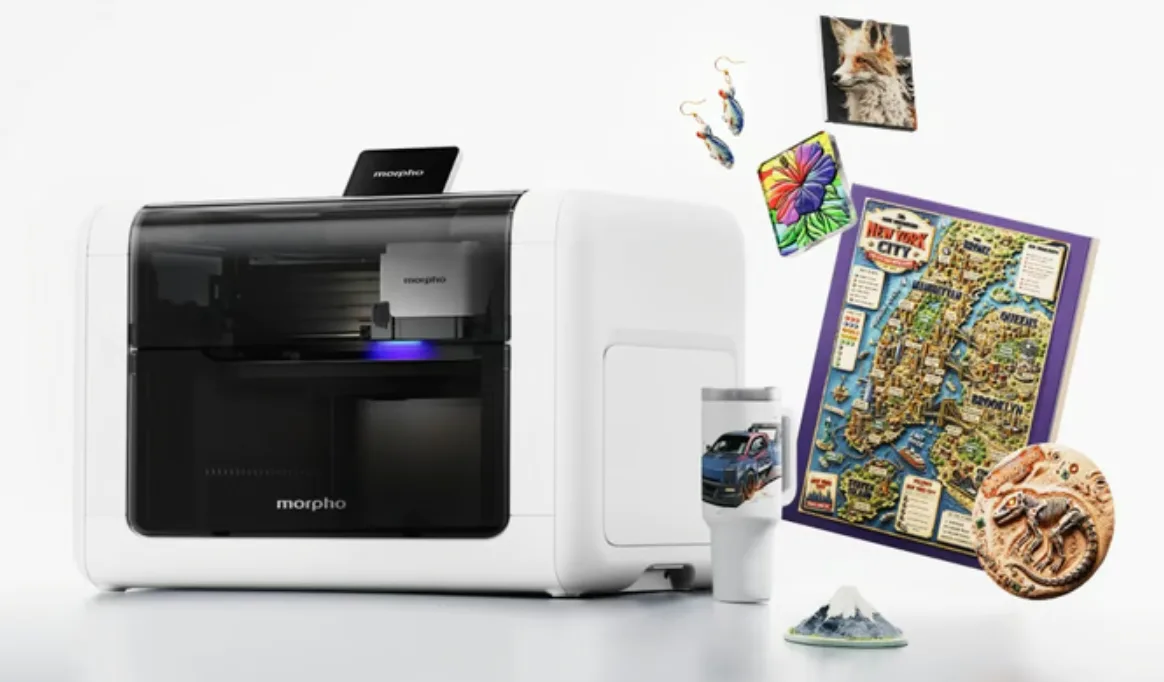
Morpho, a new brand from former DJI R&D VP Mingyu Wang, launched its first desktop UV printer on Kickstarter on August 21, 2026. The machine promises industrial-grade flatbed printing in a 32 kg enclosure small enough for a studio or small shop. Two models are offered: the F1080 at $1,599 and the Pro with an Epson i3200 head at $2,799, both as Super Early Bird prices. The campaign has already raised over $7.3 million from more than 2,000 backers.
Key Upgrades & Highlights
Moving-Gantry Design for a Larger Enclosed Work Area
Most desktop UV printers move the bed back and forth. Morpho keeps the bed still and moves the gantry overhead. This lets the enclosed chamber stay larger and taller without making the outer shell huge.
The result is a 330 x 220 x 168 mm enclosed print area inside a 660 x 430 x 390 mm box. Morpho claims that is up to four times more enclosed space than conventional desktop UV printers. A larger enclosed area matters for tall objects, batch jobs, and keeping fumes and UV light inside. The optional A3 bed extends the flat area to 420 x 330 mm.
Stereo Vision and Built-In Spectrophotometer
Morpho uses dual 8MP cameras, structured light, and a laser to scan object height and contours. The printer then adjusts the print to match the surface. A built-in spectrophotometer calibrates color automatically.
Camera alignment is common on desktop UV printers, but stereo vision with 0.2 mm claimed accuracy and live color profiling is not. The G7 Master ColorSpace certification and Delta E under 1.5 claim put Morpho in the same conversation as professional RIP workflows. Real performance will depend on lens distortion, lighting, and how well the software handles curved or reflective surfaces.
60 mm Texture Stacking
The printer can stack UV-cured ink in layers up to 60 mm high. That makes raised textures, lenticular effects, and tactile graphics possible without a separate 3D printer.
Most desktop UV printers top out at 3 mm to 5 mm of texture. A few industrial units go higher. Morpho is offering 60 mm at a $1,599 entry price. The catch is speed: a 6 x 6 x 2.2 cm resin block demo took 3 hours and 34 minutes and used 53.5 ml of ink. Texture work is powerful, but it is not fast.
Open Ink System
Morpho supports both proprietary cartridges and refillable ink bottles. You are not locked into one supply channel. The company also publishes ink prices: $13.99 for 130 ml CMYK and $23.99 for 290 ml white or varnish.
Closed cartridge systems make desktop UV printing expensive over time. Refillable bottles at roughly $0.08 to $0.11 per ml are competitive with small-format UV ink pricing. The bigger question is third-party ink compatibility. Morpho says the system is open, but the RIP and waveform tuning will decide whether third-party inks actually work well.
No Cleaning or Moisturizing Cartridges
The printer circulates white ink continuously to prevent pigment settling. This removes the need for separate cleaning and moisturizing cartridges that many desktop UV printers require.
Cleaning cartridges are a hidden cost in desktop UV printing. They add price, waste, and shelf-life headaches. Morpho says its NoClog system cuts maintenance ink use by over 90 percent. If true, that is a meaningful operating-cost advantage. We will verify it once production units arrive.
Specifications
| Models | Morpho UV Printer (F1080) / Morpho UV Printer Pro (i3200) |
| Super Early Bird Price | $1,599 (F1080) / $2,799 (Pro) |
| MSRP | $2,699 (F1080) / $4,999 (Pro) |
| Printhead | Epson F1080 (XP600) 1,080 nozzles / Epson i3200 3,200 nozzles |
| Resolution | 1,440 DPI (F1080) / 2,400 DPI (Pro) |
| Ink Channels | 6 (CMYK+W+V) / 8 (CMYK+2W+2V) |
| Enclosed Print Area | 330 x 220 x 168 mm |
| Extended Print Area | 420 x 330 x 168 mm (with A3 printbed) |
| Max Object Height | 168 mm |
| Max Load | 10 kg |
| Texture Stack Height | Up to 60 mm |
| Carriage Speed | 600 mm/s |
| Alignment System | Dual 8MP stereo cameras + structured light + laser (0.2 mm accuracy) |
| Color Accuracy | G7 Master ColorSpace certified, Delta E < 1.5 |
| Color Calibration | Built-in spectrophotometer |
| Sensing | 4 cameras total: stereo pair, 5MP macro, 2MP liveview |
| Ink System | Open refillable + proprietary cartridges; no cleaning or moisturizing cartridges |
| White Ink Circulation | 24/7 agitation to prevent settling |
| Noise Level | < 50 dB(A) |
| Footprint | 660 x 430 x 390 mm |
| Weight | Around 32 kg |
| Software | Morpho Studio (local, no cloud required for core functions) |
| Supported Surfaces | 2,000+ materials including wood, leather, glass, acrylic, film, paper |
| Estimated Shipping | Q4 2026 to January 2027 |
| Deposit | $50 refundable deposit locks Super Early Bird pricing |
Editor’s Take
The Morpho UV Printer is aimed at makers, small-batch sellers, and studios that want flatbed and texture printing without an industrial machine. The $1,599 entry price undercuts the eufyMake E1 by $900 and the HeyGears G1 by $200, while promising a taller build volume and an open ink path.
The strongest part of the package is the instrumentation. Four cameras, stereo vision, a spectrophotometer, and an industrial printhead option are not normal at this price. The moving-gantry enclosure also solves real problems with fumes, noise, and UV exposure. Compared with the xTool O1 Omni, Morpho is purely a UV flatbed without laser or DTF modules, but it costs less and offers a larger print height.
The clear risk is timing. The Kickstarter is live, but shipping is not expected until late 2026 or early 2027. No independent production-unit reviews exist yet. Ink pricing is partially published, but cost-per-print and printhead replacement costs are still unknown. If you need a UV printer now, the eufyMake E1 ships today.
FAQ
When is the Morpho UV Printer available?
The Kickstarter campaign is live now and runs until October 14, 2026. Morpho estimates factory shipping between December 2026 and January 2027, with final delivery depending on destination. Backers pay a flat shipping rate and Morpho covers customs duties.
How much does it cost?
Super Early Bird pricing is $1,599 for the F1080 model and $2,799 for the Pro. Those prices require a $50 refundable deposit placed before the campaign ends. MSRP after launch is $2,699 and $4,999 respectively.
What is the difference between the F1080 and Pro models?
The only hardware difference is the printhead. The F1080 uses an Epson XP600-class head with 1,080 nozzles and 1,440 DPI. The Pro uses an Epson i3200 head with 3,200 nozzles, 2,400 DPI, and dual white and varnish channels. Morpho says the F1080 head can be upgraded to i3200 later.
Do I need special ink or cleaning cartridges?
No. Morpho designed its EcoInk so the printer does not need cleaning or moisturizing cartridges. White ink is kept circulating to prevent clogging. You can buy proprietary cartridges or refillable bottles.
What can I print on?
Morpho lists compatibility with over 2,000 surfaces, including wood, leather, glass, acrylic, metal, film, paper, and fabric. The company also sells jigs for bottles, tumblers, and roll-to-roll UV DTF transfers.