Marcus Lau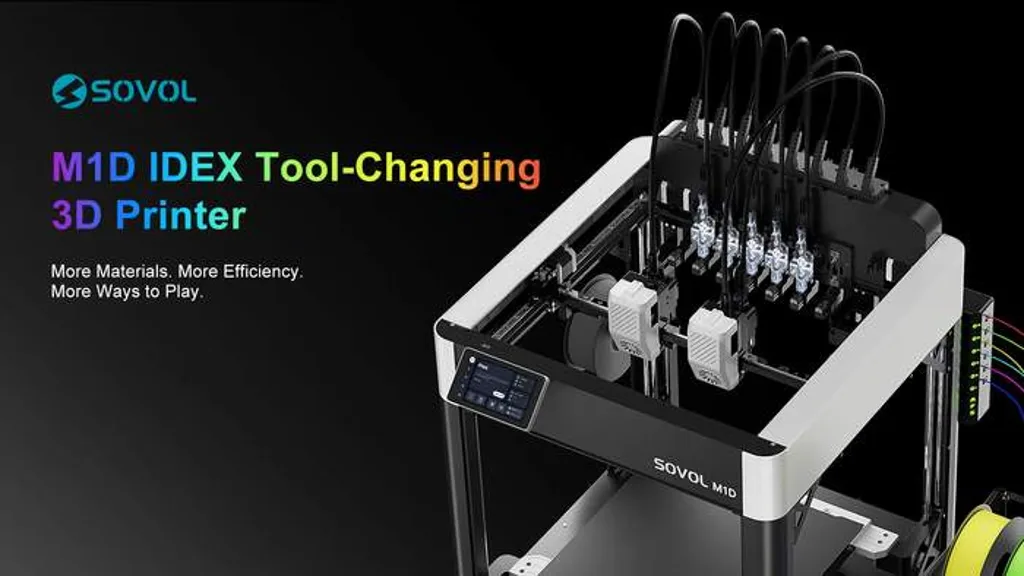
Sovol launched the M1D on Kickstarter on July 28, 2026. The machine combines an independent dual extruder with a six-position tool changer, giving users seven toolheads in total. Sovol calls the architecture DualX. The goal is to offer multi-color and multi-material printing with the copy-and-mirror benefits of IDEX and the material variety of a tool changer, while cutting the purge waste typical of single-nozzle systems.
Key Upgrades & Highlights
DualX: One Fixed Extruder Plus Six Swappable Toolheads
The left carriage carries one fixed extruder that stays active for the whole print. The right carriage docks a tool changer with six pre-loaded toolheads. The printer can use any combination of those seven heads in a single job.
This is different from a standard IDEX printer, which is limited to two materials, and from a standard tool changer, which only moves one carriage. The M1D can run true IDEX copy and mirror modes while also swapping extra toolheads for more colors or support materials. Bambu Lab’s AMS and H2D do not offer this combination. The Prusa XL has a tool changer but no IDEX dual-carriage motion.
Five-Second Toolhead Swaps
Sovol uses a motor-driven metal locking mechanism to swap toolheads in about five seconds. Each docked head preheats independently before it is engaged.
Fast swaps matter because tool-changing printers lose time every time they switch colors. Older designs often cool and reheat nozzles on demand, adding minutes per swap. The M1D keeps idle heads warm and uses a physical lock rather than magnets, which Sovol says is more stable during long prints. The five-second figure is the fastest recorded time; real-world swaps will vary.
Near-Zero Purge Waste
Because each toolhead has its own loaded filament, the printer does not need to purge the old color through a shared nozzle. Sovol claims this cuts purge waste by more than 90 percent compared with single-nozzle multi-color systems.
A single-nozzle AMS-style system can waste tens of grams of filament on purge towers for complex color prints. Dedicated toolheads avoid most of that waste. The trade-off is mechanical complexity. Tool changers have historically suffered from docking misalignment, oozing from idle tools, and slicer bugs. Sovol will need to prove reliability at this price.
Copy and Mirror Modes
IDEX lets the M1D print two identical parts at once in Copy mode, or two symmetrical parts in Mirror mode. This uses both carriages simultaneously.
Copy mode is useful for small-batch production and print farms. Mirror mode helps with paired parts like drone arms or enclosures. These modes shrink the usable X width because both carriages share the gantry, but they nearly double throughput for the right geometry. No single-nozzle tool changer can do this because it only has one active carriage.
Open-Source Firmware and OrcaSlicer
The Sovol M1D runs Klipper-based firmware. Sovol has promised to publish configurations and documentation on its Wiki and GitHub. It ships with OrcaSlicer instead of a proprietary slicer.
Open source is a real differentiator against Bambu Lab’s closed ecosystem. It means users can modify profiles, add community toolheads, and debug issues without waiting for official updates. OrcaSlicer already handles multi-material workflows well on Windows and macOS. The risk is that open-source support depends on community interest after launch.
Specifications
| Models | Sovol M1D Essential / M1D Advanced |
| Super Early Bird Price | $1,299 (Essential) / $1,599 (Advanced) |
| VIP Price with Deposit | $1,199 (Essential) / $1,499 (Advanced) |
| Planned MSRP | $1,799 (Essential) / $2,099 (Advanced) |
| Toolhead Configuration | 1 fixed extruder + 6 swappable toolheads (7 total) |
| Tool Change Time | Approximately 5 seconds |
| Build Volume (Single) | 300 x 300 x 350 mm |
| Build Volume (7-head overlap) | 240 x 300 x 350 mm |
| Max Print Speed | 600 mm/s |
| Max Acceleration | 10,000 mm/s |
| Hotend Temperature | 300C |
| Bed Temperature | AC heated PEI steel plate, 800W |
| Chamber Heating | None (Essential) / up to 60C (Advanced) |
| Supported Materials (Essential) | PLA, PETG, TPU, PVA |
| Supported Materials (Advanced) | PLA, PETG, TPU, PVA, ABS, ASA, PA, PC |
| Nozzle | Hardened steel, 0.4 mm standard; 0.6 mm and 0.8 mm options |
| Bed Leveling | Eddy current non-contact sensor |
| Calibration | Camera-based auto X/Y offset; auto Z-lift and Z-offset compensation |
| Monitoring | Chamber camera with spaghetti and foreign-object detection (OTA later) |
| Filament System | 6-channel auto loading with run-out, clog, and tangle detection |
| Interface | 5-inch touchscreen |
| Slicer | OrcaSlicer |
| Firmware | Klipper-based, open-source configs promised |
| Frame | Aluminum alloy |
| Estimated Shipping | November 2026 |
Editor’s Take
The Sovol M1D is aimed at makers, prototype developers, and small print farms that want multi-material flexibility without buying multiple machines. The $1,299 Essential price puts it close to a Bambu Lab X1 Carbon with AMS, but the M1D offers more material slots and true IDEX copy or mirror printing.
The strongest argument for the M1D is mechanical, not marketing. It is the cheapest way to get both IDEX and tool changing in one printer. Compared with the Prusa XL, which starts at a higher price and offers five toolheads without IDEX, the M1D gives you seven heads and dual-carriage modes for less money. Compared with the Bambu Lab H2D, the M1D has independent carriages rather than two nozzles on one toolhead, so it can run copy and mirror jobs.
The weakness is complexity. Sovol has never shipped a tool changer before, and this machine has more moving parts than anything in its lineup. The AI monitoring features are explicitly marked as coming later by OTA. If you need a reliable multi-color printer today, a Bambu Lab P1S with AMS is proven. The M1D is a bet on Sovol executing a much more ambitious design. Backing it now makes sense only if you understand crowdfunding risk and genuinely need both IDEX and tool changing.
FAQ
When is the Sovol M1D available?
The Kickstarter campaign opened on July 28, 2026 and runs through August 27, 2026. Sovol estimates shipping will begin in November 2026. Backers in the US, UK, Canada, Australia, and most EU countries will receive units from local warehouses. Other regions ship from China and may face import duties or VAT.
How much does the M1D cost?
Super Early Bird pricing is $1,299 for the Essential and $1,599 for the Advanced. A $20 refundable VIP deposit on Sovol’s site drops those prices to $1,199 and $1,499. Planned MSRP after Kickstarter is $1,799 and $2,099.
What is DualX?
DualX is Sovol’s name for the M1D’s hybrid motion system. One fixed extruder stays mounted on the left carriage. The right carriage carries a tool changer that can swap among six pre-loaded toolheads. That gives the printer seven toolheads total and lets it print with up to seven colors or materials in one job.
How does it reduce purge waste?
Each toolhead carries its own filament, so the printer swaps a ready-to-go nozzle instead of purging one nozzle between colors. Sovol claims this cuts purge waste by over 90 percent compared with single-nozzle filament-switching systems like Bambu Lab AMS.
Do I need a heated chamber?
The open-frame Essential handles PLA, PETG, TPU, and PVA. The Advanced adds an enclosure and 60C chamber heating for ABS, ASA, PA, and PC. If you only print basic materials, the Essential saves $300. For engineering filaments, the Advanced is the safer choice.